
■ Key Takeaways
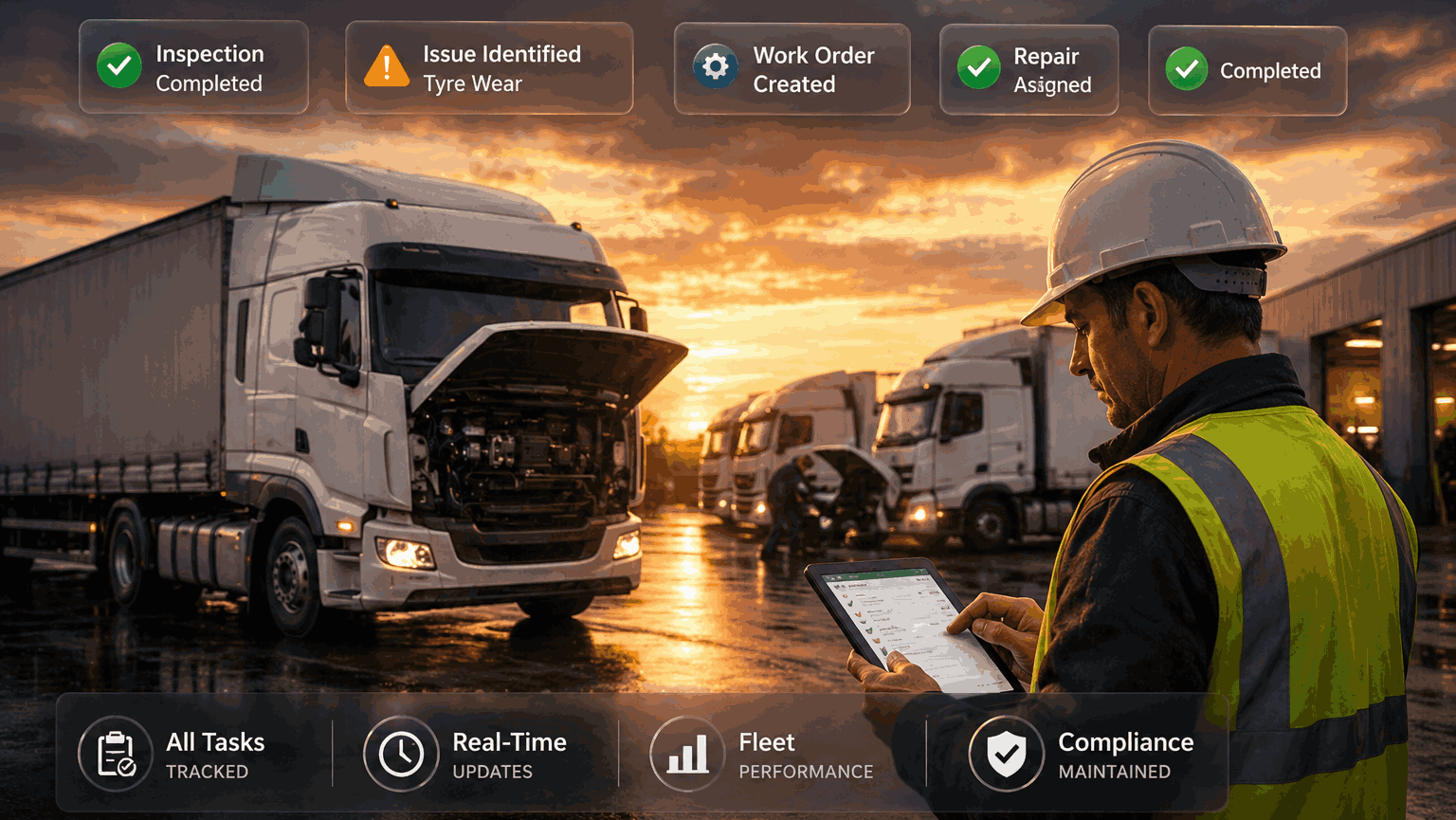
Fleet maintenance is no longer just about fixing vehicles when they break down. In 2026, it has become a strategic business function — one that directly impacts profitability, compliance, and customer satisfaction.
|
🔍
Service is due
|
→ |
⚙
Repair required
|
→ |
🚨
Breakdown happens
|
As fleets scale, this cycle becomes more complex. Without the right structure, most operations still face:
This is not simply a question of in-house vs. outsourced.
It is a fleet maintenance visibility and structure problem.
This guide breaks down both models clearly — what they mean, where each works best, and why fleet maintenance software determines the outcome regardless of which path you choose.
What Is In-House Fleet Maintenance?
In-house maintenance means managing all vehicle servicing, repairs, and inspections within your own organisation — using your own team, infrastructure, and maintenance tracking software.
What In-House Typically Includes
| Internal Technicians | → | Workshop & Parts | → | Work Orders | → | PM Schedules |
Why Fleets Choose In-House Maintenance
Limitations of In-House Maintenance
What Is Outsourced Fleet Maintenance?
Outsourced maintenance means relying on third-party service providers — vendors, authorised service centres, or contract mechanics — to handle vehicle servicing and repairs on your behalf.
Common Outsourced Providers
Why Fleets Choose Outsourced Maintenance
Limitations of Outsourced Maintenance
The problem is not the choice of vendor — it is the absence of centralised visibility.
Key Differences: In-House vs Outsourced Maintenance
When placed side by side, the trade-offs become clear. Neither model is universally superior — but each has a distinct profile depending on your fleet’s size and goals.
| Factor | In-House | Outsourced |
|---|---|---|
| Operational Control | High — full visibility | Limited, vendor-dependent |
| Setup Cost | High initial investment | Low — no infrastructure needed |
| Ongoing Cost | Lower at scale (150+ vehicles) | Variable, can escalate |
| Vehicle Downtime | Faster resolution | Depends on vendor SLAs |
| Maintenance Tracking | Strong with fleet CMMS | Often fragmented |
| Scalability | Limited — requires hiring/space | High — easy to scale |
| Predictive Maintenance | Enabled via fleet software | Rarely offered |
| Cost Transparency | Full visibility | Invoices can be opaque |
How Fleet Size Impacts the Right Choice
There is no universal answer. But fleet size is the single biggest determining factor. Here is how the decision maps out in practice.
1Small Fleets: 1–50 Vehicles — Best Choice: Outsourced
Small fleets lack the maintenance volume to justify in-house infrastructure investment. Outsourcing keeps overheads low, avoids technician shortage risk, and allows the business to stay focused on growth.
💡 Lightweight fleet maintenance software should still be used to centralise vendor records and service history — even for small fleets.
2Mid-Sized Fleets: 50–150 Vehicles — Best Choice: Hybrid Model
This fleet size sits in the most complex decision zone. A hybrid approach delivers the best of both worlds. A unified fleet CMMS is essential to coordinate both channels without data fragmentation.
3Large Fleets: 150+ Vehicles — Best Choice: In-House
At 150+ vehicles, the economics strongly favour in-house maintenance. High PM volume keeps technicians productively occupied, and integrated fleet maintenance software drives measurable fleet uptime optimisation.
The Hidden Costs Most Fleets Ignore
The true cost of fleet maintenance goes far beyond labour rates and parts invoices. Whether you choose in-house or outsourced, the biggest cost driver is what you fail to track.
⚠ Hidden Cost Scenarios
| Cost Area | Without Tracking | With Tracking |
|---|---|---|
| Spare Parts | Overstocked or unavailable | Usage tracked, stock optimised |
| Labour | Unrecorded, unaccountable | Logged per job, analysable |
| Vendor Charges | Paid without performance context | Benchmarked, compared, controlled |
Why Fleet Maintenance Software Is Non-Negotiable
Regardless of which maintenance model you choose, a purpose-built fleet CMMS is the technology layer that determines whether your model succeeds or fails. Without it, both in-house and outsourced approaches suffer from the same core problem: lack of actionable data.
|
✕ Without Fleet Software
No visibility into maintenance history
Costs scattered and uncontrolled
PM schedules missed or forgotten
Downtime invisible and unmeasured
|
✓ With Fleet Software
Full repair history per vehicle
Costs tracked per job, vehicle, and vendor
Automated PM alerts by mileage or date
Dashboards reveal patterns and guide decisions
|
This is where a vehicle maintenance management system becomes valuable — not just for recording data, but for improving decisions across the entire fleet.
The Rise of Predictive Maintenance Fleet Technology
Beyond preventive maintenance software, leading fleets are adopting predictive maintenance — using telematics, IoT sensors, and AI diagnostics to identify failures before they occur.
The Maintenance Maturity Journey
|
Reactive
Fix after failure
|
→ |
Preventive
Schedule before failure
|
→ |
Predictive
Forecast with data
|
Predictive maintenance relies on one key foundation: accurate, centralised fleet data. Platforms like TransportSimple support this foundation by enabling:
How Gaps in Maintenance Management Compound Over Time
Whether you choose in-house or outsourced maintenance, unresolved gaps in the process compound into real operational problems. Each problem feeds the next:
| Gap | Immediate Impact | Long-Term Effect |
|---|---|---|
| No maintenance tracking | No visibility into fleet health | Rising, uncontrolled costs |
| Fragmented vendor data | No performance benchmarks | Overpaying for poor service |
| Missed PM schedules | Small issues left unresolved | Repeated breakdowns |
| No vehicle service history | Decisions made without data | Poor fleet decisions at scale |
When these gaps are closed with a structured system, decisions improve, downtime reduces, and operational costs come under control — regardless of whether the work is done in-house or through vendors.
What Changes When Visibility Is in Place
When maintenance is managed through a structured system — whether the work is in-house or outsourced — the impact is visible across the entire operation:
This is the shift from reactive to structured fleet maintenance — and it applies equally whether your team does the work or a vendor does.
Final Thought
Choosing between in-house and outsourced fleet maintenance is important.
But it is not the real factor that determines long-term success.
What truly matters is how well you track, manage, and optimise your maintenance operations.
An in-house setup without structured maintenance tracking can quickly become inefficient and costly. An outsourced model without centralised visibility often leads to delays, inconsistent costs, and limited control.
The most efficient fleets today don’t rely on guesswork or manual coordination. They operate with connected systems that bring maintenance, costs, and operations into one unified view.
This is the shift TransportSimple is built to support — helping fleet teams move from scattered, informal processes to a reliable, structured way of managing daily maintenance at any scale.
🚙 About This Page
This page is created by the TransportSimple team. The insights shared here come from real conversations with fleet owners, transport managers, and drivers who deal with daily maintenance challenges, recurring breakdowns, and operational pressure. Over time, we’ve spoken with 100+ fleet owners across different countries and fleet sizes — and one thing is consistent: maintenance problems repeat everywhere when structure is missing.
These blogs are written by observing real-world patterns: where maintenance slips, where costs rise silently, and how disciplined fleets manage growth without chaos. The goal is not to provide theory, but to share practical thinking that works on the ground.



Leave a Reply